There are neighborhoods in Tulsa that people brag about. And then there's Kendall Whittier — a neighborhood that did the hard work, told the truth about what it had become, and built something
Dated: September 8 2026
Views: 33
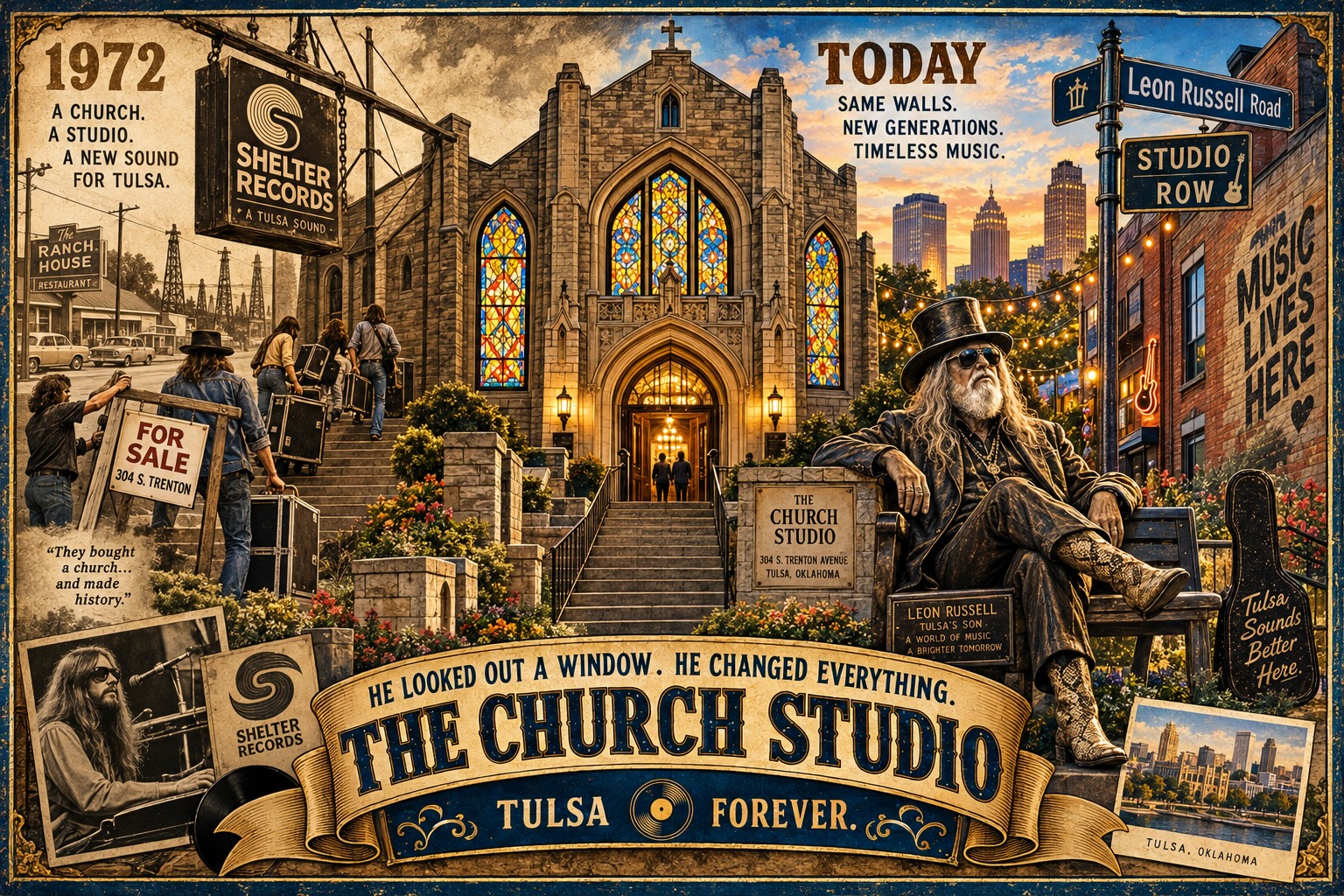
The Day Leon Russell Looked Out a Window and Changed Everything
It was a lunch break.
Across the street sat a dilapidated stone church. Abandoned. A for-sale sign out front.
They walked over. Climbed the steps. Stood on the porch of a building that had been sitting empty on South Trenton Avenue since who knows when. And right there — on those steps — Leon decided it was exactly what he'd been looking for.
He bought it that afternoon.
What happened inside that building over the next several years changed American music in ways that are still being felt today.
The Grace Methodist Episcopal Church was built in 1915 — one of the earliest churches constructed in the new city of Tulsa. It survived the Race Massacre of 1921. It changed denominations multiple times over the decades — First United Brethren, First Evangelical United Brethren, First Church of God — each congregation passing it along until it sat empty and forgotten in the Pearl District.
The original structure was brick. The stone facade you see today — that castle-like exterior — was added in the mid-1950s when the church ran out of money and only partially covered the original brick. Half castle, half abandoned church. All character.
When Leon bought it he didn't just buy the church. He bought the surrounding properties — fourteen houses on the block — and set them up as lodging for visiting artists, engineers, and producers. If you came to Tulsa to record at The Church, Leon had a house for you. The whole block was the studio.
The ceiling inside was forty feet high. The acoustics were unlike anything a purpose-built studio could manufacture. Leon converted the sanctuary into the main recording space — the altar became the control room, the pews came out, the hardwood floors stayed. The bones of a 1915 Methodist church became the sonic foundation for some of the most important recordings of the 1970s.
Leon's vision, according to those who were there, was to do all genres of music and help musicians fulfill their dreams without all the Los Angeles record company restrictions and entanglements. No suits. No label politics. No Hollywood. Just music.
Before you ever walk inside The Church Studio, stop at the front steps.
Those chips and nicks on the stone stairs — that's from all of the gear that was hauled up and down for recording sessions and jams during the building's Shelter Records years. Every dent in that stone is a guitar case, an amp, a drum kit, a keyboard being wrestled up those steps for a session. The building carries the physical marks of the music that was made inside it.
Nobody polished those away. They're still there.
Here's the list. Read it slowly.
Willie Nelson. Eric Clapton. Bob Dylan. George Harrison. Ringo Starr. Stevie Wonder. Bob Marley. Bob Seger. Jimmy Buffett. Tom Petty. Freddie King. JJ Cale. The Gap Band. Kansas. Dwight Twilley. Peter Tosh. Phoebe Snow. Dr. John. Kenny Loggins. Roy Clark. Bonnie Raitt. Taj Mahal. The Dropkick Murphys. Hanson. Ronnie Dunn. Admiral Twin. Jesse Aycock.
Tom Petty, with his early band Mudcrutch, signed his first record deal with Shelter Records there. The band that became Tom Petty and the Heartbreakers got their start on the steps of a church in Tulsa, Oklahoma.
The Dropkick Murphys — the hard-charging Boston punk band — recorded a full album at The Church Studio in 2022, putting Woody Guthrie's lyrics to music. Boston punk. Tulsa church. Woody Guthrie. That sentence only makes sense in this building.
The archive includes items from the Concert for Bangladesh and the Mad Dogs and Englishmen tour — including a guitar from the 1971 Concert for Bangladesh organized by George Harrison. There are Russell's hats, his canes, handwritten music, promotional items, concert tickets. One of his canes has his image carved into it. And somewhere in the archive there is a container reserved specifically for Bob Dylan items. There are also 7-Eleven Slurpee cups with Leon Russell's face on them. Because of course there are.
Leon and Denny Cordell fell out in 1976. In the settlement Cordell got Shelter Records and Leon left to start his own label — Paradise Records. He sold The Church Studio in 1978.
After Leon's time, the studio kept recording under the ownership of Steve Ripley and Charlene Ripley — Steve being the leader of The Tractors — and later Randy and Debbie Miller. It never stopped being a place where music happened. It just got quieter.
Leon Russell died November 13, 2016. He was 74 years old. He is buried at Memorial Park Cemetery in Tulsa — alongside Roy Clark, another legend who called this city home.
After he died, fans covered the steps with flowers and cards, turning them into an impromptu shrine. The front steps of a building on South Trenton Avenue in the Pearl District became a memorial site for one of the most important musicians in American history.
Teresa Knox bought the building after Leon's death and shepherded the National Register application through to completion. The Church Studio was added to the National Register of Historic Places on September 8, 2017 — less than a year after Leon died.
Then she went further. Knox poured millions into a complete renovation — new recording equipment, restored spaces, new infrastructure — while keeping everything that made the building what it is. The renovation was completed in 2022.
A life-sized bronze sculpture of Leon Russell — designed by artists Jim Franklin and Teresa Knox over more than three years — now greets visitors from the courtyard entrance. Wrangler denim jacket. Snakeskin boots. Cross necklace. Top hat. Six feet tall and unmistakably Leon.
Today The Church Studio operates as a working recording studio, an audio engineering school, a museum, and a community performance space. Tours run Monday through Saturday. The archive holds more than 5,000 artifacts, documents, recordings, and pieces of memorabilia.
Teresa Knox also owns the Shelter Records trademark. The label Leon Russell built is still alive — still in Tulsa, still on South Trenton Avenue.
The Church Studio was awarded a $393,000 Route 66 Grant to install a large sculpture of an egg — the symbol of Shelter Records — diagonally across Third Street from the studio. The egg will weigh thousands of pounds, will be lit at night, and will include a large "S" within its interior — a nod to Shelter Records.
Teresa Knox called it a future selfie spot. She's probably right.
The neighborhood around The Church Studio is growing into what they're calling Studio Row — record shops, galleries, eateries, and now a new mixed-use retail development replacing a former Chevron station across the street. The block that Leon Russell built a dream on in 1972 is becoming something again.
A man looked out a restaurant window in 1972 and saw a for-sale sign on an abandoned church. He walked across the street, climbed the steps, and decided that was the place.
Because of that lunch break — Bob Dylan recorded here. George Harrison. Tom Petty got his start here. The Gap Band found their sound here. Eric Clapton kept coming back to Tulsa because of what was happening in this building.
The steps are still chipped from the gear that went up and down them. The acoustics in a forty-foot sanctuary ceiling still do something to music that no modern studio can replicate. And Leon Russell is standing in the courtyard in bronze — top hat, snakeskin boots — right where he belongs.
304 South Trenton Avenue. Leon Russell Road. Pearl District, Tulsa, Oklahoma.
Go.
Richard Johns is a lifelong north Tulsan, Will Rogers High grad, and broker associate with Avenue 23 Realty. He believes knowing a city means knowing all of it.

I’m Richard Johns, a Tulsa native and licensed real estate broker with over 17 years of experience helping people navigate one of the biggest decisions of their lives. Tulsa isn’t just whe....
There are neighborhoods in Tulsa that people brag about. And then there's Kendall Whittier — a neighborhood that did the hard work, told the truth about what it had become, and built something
The Day Leon Russell Looked Out a Window and Changed EverythingIt was a lunch break.Leon Russell and his Shelter Records partner Denny Cordell were sitting in a booth at The Ranch House Restaurant
It started as a boarding school for Native American girls in Muskogee with no money, no campus, and no guarantee it would survive the year.Today it sits on 230 acres of Collegiate Gothic
There's a neighborhood in Tulsa that most people drive through without realizing they're in it. It sits just east of downtown, bordered by the highway to the north and Route 66 to the south, and it
 MLS Technology® Oklahoma; All information deemed reliable but not guaranteed. All properties are subject to prior sale, change or withdrawal. Neither listing broker(s) or information provider(s) shall be responsible for any typographical errors, misinformation, misprints and shall be held totally harmless. Listing(s) information is provided for consumer's personal, non-commercial use and may not be used for any purpose other than to identify prospective properties consumers may be interested
in purchasing. The data relating to real estate for sale on this website comes in part from the Internet Data Exchange program of the Multiple Listing Service. Real estate listings held by brokerage firms other than Avenue 23 Realty may be marked with the Internet Data Exchange logo and detailed information about those properties will include the name of the listing broker(s) when required by the MLS. Copyright ©2026 All rights reserved.
Last Updated: September 21, 2026 1:43 PM UTC
Show More...
MLS Technology® Oklahoma; All information deemed reliable but not guaranteed. All properties are subject to prior sale, change or withdrawal. Neither listing broker(s) or information provider(s) shall be responsible for any typographical errors, misinformation, misprints and shall be held totally harmless. Listing(s) information is provided for consumer's personal, non-commercial use and may not be used for any purpose other than to identify prospective properties consumers may be interested
in purchasing. The data relating to real estate for sale on this website comes in part from the Internet Data Exchange program of the Multiple Listing Service. Real estate listings held by brokerage firms other than Avenue 23 Realty may be marked with the Internet Data Exchange logo and detailed information about those properties will include the name of the listing broker(s) when required by the MLS. Copyright ©2026 All rights reserved.
Last Updated: September 21, 2026 1:43 PM UTC
Show More...
