There are neighborhoods in Tulsa that people brag about. And then there's Kendall Whittier — a neighborhood that did the hard work, told the truth about what it had become, and built something
Dated: September 8 2026
Views: 57
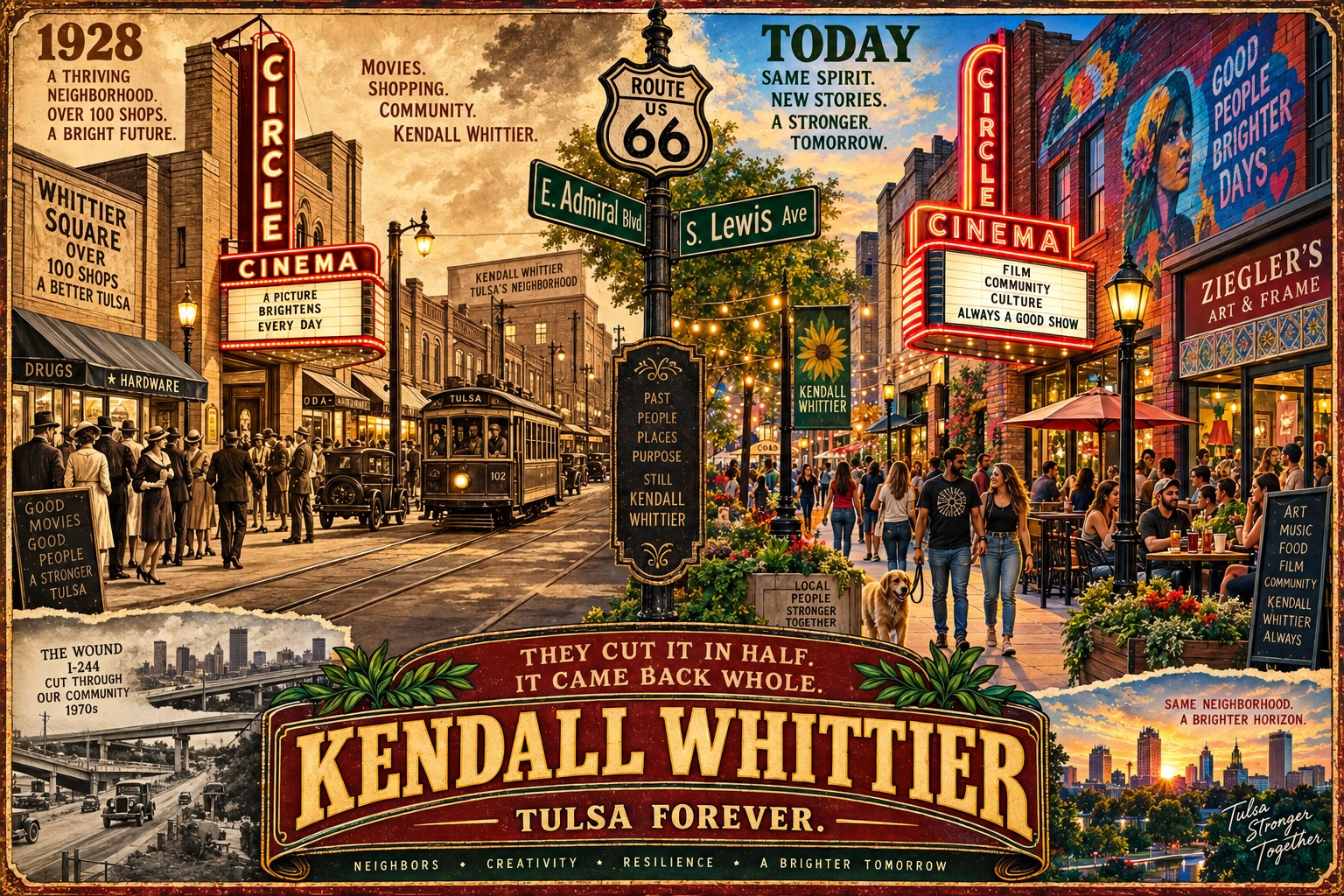
There are neighborhoods in Tulsa that people brag about. And then there's Kendall Whittier — a neighborhood that did the hard work, told the truth about what it had become, and built something real out of the wreckage.
This is not a neighborhood that got polished up for outsiders. This is a neighborhood that fought for itself from the inside out. And won.
Where It Came From
The land that became Kendall Whittier was purchased from the Creek Nation by a man named Alvin T. Hodge in 1903 — the same year Tulsa was still more cattle town than city. Hodge used it as a pasture. He sold it for development in 1906, one year before Oklahoma statehood.
The neighborhood grew up around two things — a trolley line and two schools. The Tulsa Street Railway connected Whittier Square to downtown Tulsa in 1909, making this one of Tulsa's original streetcar suburbs. John Greenleaf Whittier School was built in 1916. Henry Kendall College — what the University of Tulsa was called before it became TU — had already moved to the eastern edge of the neighborhood in 1907, becoming Tulsa's first institution of higher education.
The neighborhood took its name from both. Kendall from the college. Whittier from the school. Two institutions that shaped generations of Tulsans gave this place its identity before it even knew what it was going to become.
Tulsa's First Suburban Shopping Center
By the late 1920s Whittier Square — the commercial heart of Kendall Whittier along Lewis Avenue between Admiral and First Street — had become something remarkable. Over 100 stores. A post office substation. A library branch. A movie theater. Everything a neighborhood needed without ever touching downtown.
It was Tulsa's first suburban shopping center. Not Utica Square. Not anywhere south. Right here. Lewis and Admiral. Built by working people who needed a place that was theirs.
Route 66 ran through it twice. The original 1926 alignment ran along Admiral Boulevard — right past the corner where Circle Cinema still stands today. When the alignment shifted to 11th Street it bordered the neighborhood from the south. Kendall Whittier didn't sit near Route 66. It sat inside it. Two alignments of the most famous highway in America ran through or along this neighborhood at the same time.
Circle Cinema
On July 15, 1928, a single-screen silent picture house opened at 10 South Lewis Avenue on the original Route 66 alignment. The first film shown was "Across the Atlantic." The Circle Theatre was Tulsa's first suburban movie house — and it is still standing today, the oldest theater in the city.
It had a working Robert Morton pipe organ from the beginning. It did. And that organ — restored and still playable — is still in the building today.
The Circle had a good run through the 1940s and 50s. Teenagers came from across Tulsa to see James Bond movies and Saturday serials. Then television came and the crowds thinned. The theater closed and reopened on Christmas Day 1964 with a new focus — "first-run quality entertainment" — debuting with Dr. Strangelove.
Then the neighborhood changed. In 1978 the Circle closed again and reopened as an X-rated theater. Community group ACORN protested outside. Someone tried to pivot it to a Spanish-language theater in the 1980s. That didn't work either. The building sat vacant for ten years.
In 2002 a man named Clark Wiens and a group of supporters formed the Circle Cinema Foundation. They bought the building. They restored it. They brought back the pipe organ. They reopened it in October 2004 as a nonprofit independent theater — the only one in Tulsa.
Today Circle Cinema is a Sundance Film Festival satellite screen. It hosts naturalization ceremonies — new American citizens taking their oath in the same building where Tulsans watched silent films in 1928. It has a Walk of Fame on the sidewalk outside. It hosts first-run independent films, documentaries, special events, and community programming 365 days a year.
The Circle Cinema's own website gives credit where it's due: it was Circle Cinema and Ziegler's Art and Frame that kicked off the renaissance of Kendall Whittier. Two businesses that stayed when everyone else left.
Ziegler's
Dan Ziegler opened Ziegler Art and Frame at 6 North Lewis Avenue in 1973. One storefront. Custom frames. Art supplies. Right in the middle of what would become — through the 1970s, 80s, and 90s — Tulsa's red light district.
Dive bars. Strip clubs. Adult bookstores. X-rated movies at the Circle. Vacant storefronts. Criminal activity. The Tulsa World called Ziegler's "an outpost of respectability in the center of what was considered Tulsa's red light district."
Ziegler's didn't leave.
Dan Ziegler's son-in-law Alan Morrow came in and eventually his son Trent Morrow joined him. Three generations of the same family. One storefront that grew to 20,000 square feet across several buildings. They held the corner of Lewis and Admiral through the worst of it and watched the neighborhood come back around them.
More than 50 years later Ziegler's is still there. Same corner. Same family. Same commitment to art and the neighborhood that nobody else believed in during the dark years.
What Killed It — And What Didn't
The neighborhood didn't decline because of the people who lived there. It declined because of a highway.
In the 1960s I-244 was built directly through the center of Whittier Square — the same displacement playbook used on Greenwood a decade earlier. The highway cut the commercial district in half, scattered residents, killed foot traffic, and left storefronts without customers. The Tulsa Area Planning Commission rezoned large sections of the neighborhood from single-family to multi-family. Owner-occupied homes gave way to rental properties. The perception of decline became the fact of decline.
By the early 2000s Kendall Whittier had a 35 percent occupancy rate in its commercial district. It was known throughout Tulsa as a place to avoid. The stigma was real. And like most stigma it was applied from the outside by people who hadn't been there in years.
The people who actually lived there knew something different was possible.
The Comeback
In 2010 Kendall Whittier Main Street was formed. They started with 35 percent occupancy and a neighborhood that most of Tulsa had written off.
They chose arts and culture as their focus deliberately. Not because it was trendy. Because the bones of this neighborhood — Circle Cinema, Ziegler's, the historic Whittier Square buildings, the proximity to TU, the Route 66 heritage — were already cultural assets waiting to be activated.
They launched a façade grant program. They grew an events calendar from one public event in 2013 to more than 20 events annually — the bilingual Lights On celebration, the Mercado, art walks, live music, community gatherings that brought people back into a neighborhood they'd been told to avoid. They recruited businesses that fit the character of the place rather than chasing whoever would sign a lease.
The result: 40 new businesses opened. $158 million in private dollars reinvested. 350 jobs created. Occupancy went from 35 percent to 100 percent.
In 2020 Kendall Whittier Main Street was named one of three winners of the Great American Main Street Award — the highest honor in the country for commercial district revitalization. Out of every Main Street program in America, including programs in Boston and other major cities, a neighborhood in Tulsa, Oklahoma that had been called a red light district ten years earlier won one of three spots.
One longtime resident named Kirk Wester put it best: "We've been able to create an inclusively grown community. In fact, what the data shows, it's the only inclusively grown community in the city of Tulsa."
What Kendall Whittier Is Today
Diverse in every sense of the word. Latino families who have been here for generations alongside new arrivals, Black Tulsans, white Tulsans, artists, students, immigrants, longtime residents, and people who found the neighborhood through Tulsa Remote and decided to stay. This is not a neighborhood that gentrified its original residents out. It grew with them.
Two miles east of downtown. Walking distance to the University of Tulsa. Blocks from Mother Road Market on Route 66. Circle Cinema on the corner of Lewis and Admiral where it has been since 1928. Ziegler's next door where it has been since 1973. Heirloom Rustic Ales. Pancho Anaya Bakery, whose family recipe goes back to Michoacán in 1912. Working artist studios. Coffee shops. Music venues. Murals on nearly every wall.
Whittier Square — Tulsa's first suburban shopping center, cut in half by a highway in the 1960s — is on the National Register of Historic Places. The neighborhood it anchors is coming back stronger than it was before the highway came through.
The stigma is still there in some corners of Tulsa. People who haven't been there in fifteen years still repeat what they heard in 2005. That's their loss.
Go see it for yourself. Walk Lewis Avenue on a Saturday morning. Get breakfast. Stop into Ziegler's. See what's playing at the Circle. Look at the murals. Talk to the people who live there.
Kendall Whittier doesn't need to prove anything to anyone anymore. It already did that.
Richard Johns is a lifelong north Tulsan, Will Rogers High grad, and broker associate with Avenue 23 Realty. He believes knowing a city means knowing all of it.

I’m Richard Johns, a Tulsa native and licensed real estate broker with over 17 years of experience helping people navigate one of the biggest decisions of their lives. Tulsa isn’t just whe....
There are neighborhoods in Tulsa that people brag about. And then there's Kendall Whittier — a neighborhood that did the hard work, told the truth about what it had become, and built something
The Day Leon Russell Looked Out a Window and Changed EverythingIt was a lunch break.Leon Russell and his Shelter Records partner Denny Cordell were sitting in a booth at The Ranch House Restaurant
It started as a boarding school for Native American girls in Muskogee with no money, no campus, and no guarantee it would survive the year.Today it sits on 230 acres of Collegiate Gothic
There's a neighborhood in Tulsa that most people drive through without realizing they're in it. It sits just east of downtown, bordered by the highway to the north and Route 66 to the south, and it
 MLS Technology® Oklahoma; All information deemed reliable but not guaranteed. All properties are subject to prior sale, change or withdrawal. Neither listing broker(s) or information provider(s) shall be responsible for any typographical errors, misinformation, misprints and shall be held totally harmless. Listing(s) information is provided for consumer's personal, non-commercial use and may not be used for any purpose other than to identify prospective properties consumers may be interested
in purchasing. The data relating to real estate for sale on this website comes in part from the Internet Data Exchange program of the Multiple Listing Service. Real estate listings held by brokerage firms other than Avenue 23 Realty may be marked with the Internet Data Exchange logo and detailed information about those properties will include the name of the listing broker(s) when required by the MLS. Copyright ©2026 All rights reserved.
Last Updated: September 21, 2026 1:43 PM UTC
Show More...
MLS Technology® Oklahoma; All information deemed reliable but not guaranteed. All properties are subject to prior sale, change or withdrawal. Neither listing broker(s) or information provider(s) shall be responsible for any typographical errors, misinformation, misprints and shall be held totally harmless. Listing(s) information is provided for consumer's personal, non-commercial use and may not be used for any purpose other than to identify prospective properties consumers may be interested
in purchasing. The data relating to real estate for sale on this website comes in part from the Internet Data Exchange program of the Multiple Listing Service. Real estate listings held by brokerage firms other than Avenue 23 Realty may be marked with the Internet Data Exchange logo and detailed information about those properties will include the name of the listing broker(s) when required by the MLS. Copyright ©2026 All rights reserved.
Last Updated: September 21, 2026 1:43 PM UTC
Show More...
